How to Improve Google Ads ROI: 8 Proven Methods That Actually Work
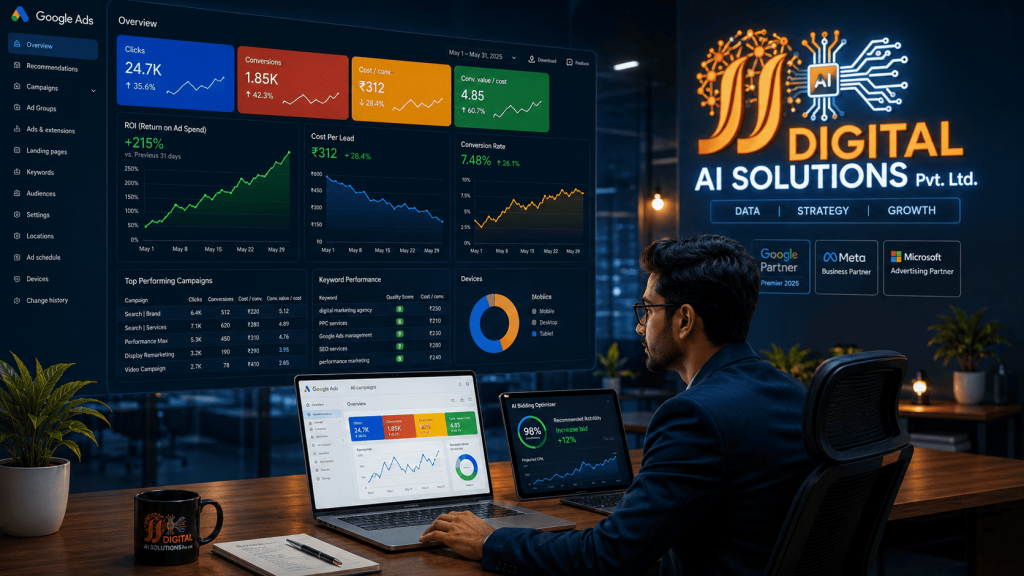
Your Google Ads are running, money is flowing out, some leads are flowing in – and you suspect, correctly, that the return could be better. The good news: Google Ads ROI is one of the most improvable numbers in marketing, because every component of it – who clicks, what they pay, where they land, what happens next – is measurable and adjustable.
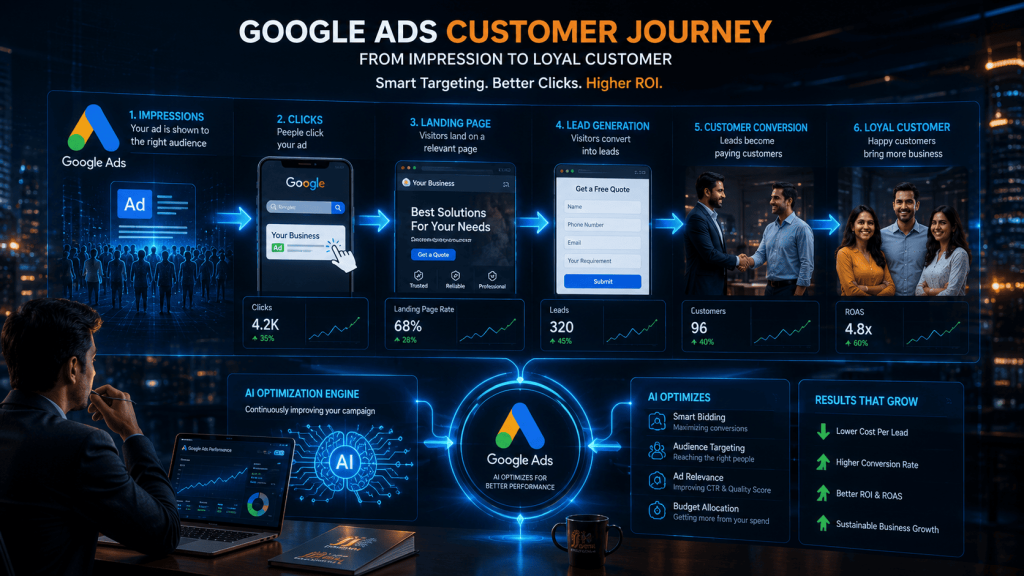
This guide gives you the eight highest-leverage improvements, in rough order of impact. None require increasing your budget; all work by making the existing budget do more. Together they routinely double or triple a campaign’s return.
First: Know Your Real Numbers
ROI improvement starts with measuring the right thing. Clicks and impressions are activity, not results. The chain that matters: spend → clicks → leads → customers → revenue. Your governing metric is cost per lead (and ideally cost per customer). If you cannot state your current cost per lead, that is improvement zero – set up complete conversion tracking today (forms, call clicks, WhatsApp), because every optimisation below depends on it.
Method 1: Prune Keywords Ruthlessly by Lead Data
In every account, a minority of keywords produce the majority of leads, while others quietly consume budget producing clicks that never convert. With tracking live, the search terms and keyword reports reveal exactly which is which. Pause the spenders, feed the producers.
The discipline: monthly, rank keywords by cost per lead. Anything costing multiples of your average with no leads after meaningful spend gets paused. This single reallocation often improves ROI more than any other action.
Method 2: Build Out Negative Keywords Continuously
Every irrelevant search you exclude redirects budget toward genuine prospects. Review the search terms report weekly and add negatives for every “free,” “job,” “course,” “meaning,” and off-target variation that appears. A mature account has hundreds of negatives – each one a small permanent leak sealed.
Method 3: Match Landing Pages to Searches
ROI’s biggest hidden lever lives after the click. A searcher for “modular kitchen price Bhubaneswar” should land on a page about modular kitchen pricing in Bhubaneswar – not your homepage, not a generic services page. Message match between search, ad, and page is what converts paid visitors into enquiries.
- One focused page per campaign theme
- Headline echoing the search intent
- One clear action: prominent form, call button, or WhatsApp
- Trust elements: reviews, photos, specifics
- Instant loading, flawless on mobile – where most clicks happen
Improving a landing page from mediocre to good frequently doubles conversion rate – instantly halving cost per lead with zero targeting changes.
Method 4: Write Ads That Pre-Qualify
The best ad is not the one everyone clicks – it is the one the RIGHT people click. Include specifics that attract buyers and repel non-buyers: prices or ranges where sensible, service area, what you do and do not offer. “Premium modular kitchens from ₹2.5L – Bhubaneswar” costs you the freebie-hunters’ clicks and saves you their click fees. Every avoided wrong click is ROI.
Method 5: Schedule and Geo-Target with Precision
Your data will show leads clustering by hours and localities. Concentrate budget there: bid up during converting hours, down or off during dead ones; tighten geography to where customers actually come from. Generic 24/7 everywhere targeting is paying full price for your worst segments.
Method 6: Test One Thing at a Time, Always
Continuous testing compounds: two ad variants running against each other, a landing page headline test, a new keyword theme piloted with small budget. Keep tests single-variable so results are readable, declare winners on data, and immediately start the next test. Accounts that always have one live test improve permanently; accounts that do not, drift.
Method 7: Use Smart Bidding – After You Have Data
Google’s automated bidding (Maximise Conversions, Target CPA) can outperform manual bids – but only once your account has tracked conversions to learn from. Automation on a no-data account optimises noise. Sequence matters: tracking first, manual discipline second, automation third, supervision always.
Method 8: Follow Up Like the Leads Cost Money – Because They Did
ROI dies quietly in slow follow-up. A lead called within five minutes converts at a multiple of one called the next day – while a competitor’s ad is one search away. Instant alerts, same-hour response, and a simple follow-up sequence for non-answers protect everything the campaign achieved. The cheapest ROI gain in advertising is answering faster.
A Real Business Example
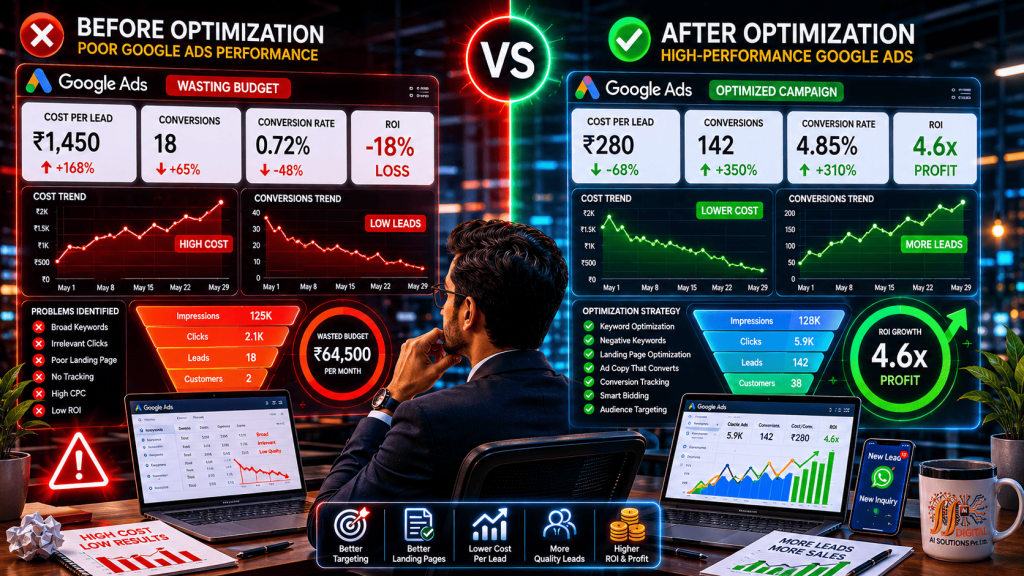
A dental clinic ran ads at a stubborn ₹1,400 cost per lead. The improvement sequence: full tracking installed (revealing two keyword themes ate 60% of budget with near-zero leads – paused), negatives built weekly, and the homepage destination replaced with a focused implant landing page including pricing ranges and reviews. Ads were rewritten with pricing to pre-qualify, scheduling concentrated on converting hours, and a front-desk five-minute callback rule instituted.
Nothing about the budget changed. Ninety days later: cost per lead ₹520, lead volume up 2.5x, and – because pricing in ads pre-qualified – the consultation-to-treatment rate improved too. Every gain came from configuration, not spend.
Frequently Asked Questions
What is a good ROI for Google Ads?
It varies by industry and customer value, but the working logic is universal: your cost per customer must sit comfortably below customer value. Track cost per lead, know your lead-to-customer rate, and judge against your margins – not against generic benchmarks.
How fast can ROI improve after changes?
Landing page and follow-up improvements show within days. Keyword pruning and negatives within one to two weeks. Bidding automation needs several weeks of data. A full optimisation cycle typically transforms accounts within one quarter.
Should I increase budget to improve results?
Not until the leaks are sealed. Scaling a wasteful account scales the waste. Optimise to a strong cost per lead first; then – and only then – additional budget multiplies a working machine.
Why did my ROI suddenly drop?
Usual suspects: a competitor entered or raised bids, search behaviour shifted seasonally, an auto-applied recommendation changed your settings, or your landing page broke (forms fail silently more often than anyone expects). The tracking trail diagnoses which.
Does Quality Score affect ROI?
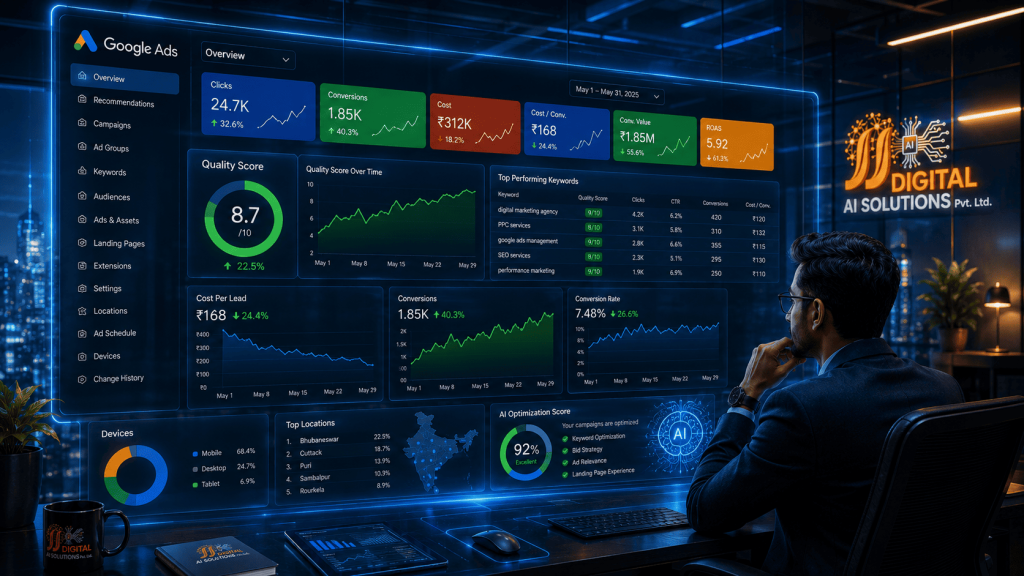
Directly – Quality Score is Google’s rating of how relevant your keywords, ads, and landing pages are to each other, and higher scores literally lower your cost per click for the same positions. The improvements in this guide – tight keyword themes, message-matched ads, and focused landing pages – raise Quality Score as a byproduct, which means well-optimised accounts get a compounding discount: better targeting produces cheaper clicks, which lowers cost per lead twice over.
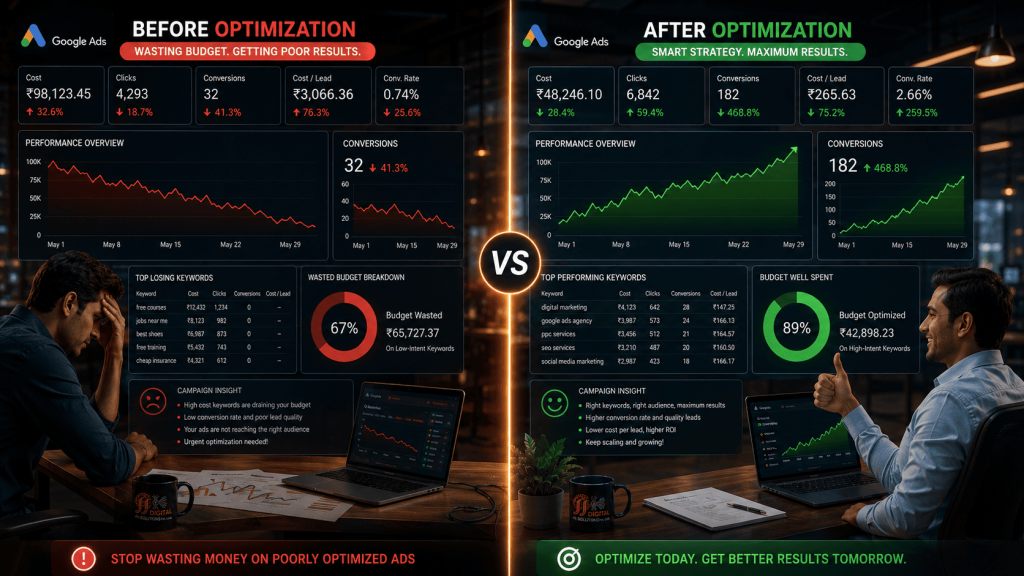
JJ Digital: ROI Engineering for Google Ads
Improving ad ROI is systematic work – measurement, pruning, message match, testing, and follow-up discipline – executed weekly. That system is exactly what JJ Digital runs for every ads client.
What JJ Digital Brings to Your Business
- Complete tracking architecture – the measurement everything depends on
- Data-driven pruning and reallocation – budget flows to what produces
- Landing pages engineered to convert the traffic you pay for
- Perpetual testing rhythm – your account improves every month, permanently
- Cost-per-lead reporting – the number that matters, shown plainly
Same budget, multiplied results – that is what optimisation means. Let us show you the gap in your account.
Ready to grow? Contact JJ Digital today for a free consultation. Let us look at your business and show you exactly what is possible.
JJ Digital – Digital Marketing & AI Solutions, Bhubaneswar, Odisha
Leave a Reply