
Email Marketing vs Social Media: Which Actually Nurtures a Lead Toward a Sale

Social media and email marketing are often discussed as if a business must choose one over the other, in practice, the two channels excel at fundamentally different stages of a customer’s journey, and understanding which does what is more useful than treating this as a simple either-or competition.
What Social Media Does Best: Discovery and Awareness
Social media platforms excel at reaching people who have never heard of a business before, a well-targeted post or ad can appear in front of a completely new, relevant audience, building initial awareness and brand recognition at a scale that a private, opt-in email list simply cannot match in its early stages. Social media is, in this sense, the better tool for the very top of a customer’s journey, the first introduction.
What Email Marketing Does Best: Nurturing and Conversion
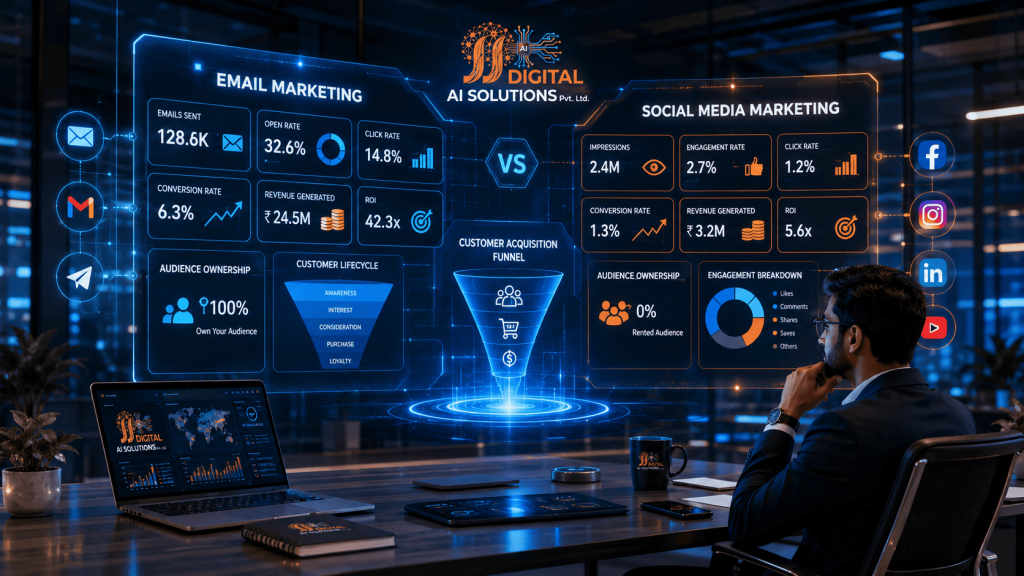
Once someone has shown genuine interest, by visiting a website, signing up for an offer, or engaging meaningfully with social content, email marketing becomes the more effective tool for nurturing that interest toward an actual purchase decision. A subscriber who receives a thoughtful, well-timed sequence of emails specifically addressing their interest tends to convert at a meaningfully higher rate than the same person scrolling past an occasional social media post in a crowded, algorithm-controlled feed.

Why Algorithm Dependency Makes Social Media Less Reliable for Nurturing
A business’s organic social media reach is entirely subject to the platform’s algorithm, which can and does change without warning, sometimes dramatically reducing how many followers actually see a given post regardless of how engaged that follower base genuinely is. Email, by contrast, delivers directly to a subscriber’s inbox without this algorithmic filtering, meaning a well-built email list represents a meaningfully more stable, reliable channel for ongoing nurturing than social media reach alone.

A Side-by-Side Comparison for Lead Nurturing Specifically
- Reach reliability: Email reaches a subscriber’s inbox directly; social media reach depends entirely on the platform’s current algorithm
- Message depth: Email supports longer, more detailed, more personalised messaging; social media favours short, broadly appealing content
- Timing control: Email can be triggered by specific subscriber behaviour (an automated sequence after signup); social media posting is largely broadcast on a fixed schedule to everyone simultaneously
- Cost per nurtured lead: Email marketing’s direct cost per message is typically lower than equivalent paid social media reach to the same audience size
- Audience ownership: An email list is a business asset the business fully controls; a social media following exists on a platform the business does not own or control

Why the Right Answer Is Usually Both, Used for Different Purposes
The most effective small business marketing strategies typically use social media specifically to attract and build initial awareness with a broader audience, and email marketing specifically to convert the genuinely interested portion of that audience into actual customers and repeat business, treating the two as sequential stages of one funnel rather than competing, mutually exclusive channels deserving an either-or decision.
A Practical Workflow Combining Both Channels
A practical sequence many small businesses use successfully starts with social media content and advertising driving traffic to a website or landing page offering something of genuine value in exchange for an email signup, that new subscriber then enters an automated email nurturing sequence introducing the business and its offerings in more depth than a social post ever could, eventually leading to a purchase decision the social media channel alone was less equipped to close.
A Real-World Comparison: Two Businesses, Two Different Outcomes
Consider two small businesses with similarly sized social media followings, one relies purely on organic social media posts to nurture interest, watching engagement fluctuate unpredictably as the platform’s algorithm shifts month to month, while the other captures a portion of that same social audience into an email list and nurtures them through a structured, automated sequence the business fully controls. Over a year, the second business typically experiences considerably more stable, predictable lead nurturing, since its core nurturing channel is not subject to a third party’s algorithm changes the way pure social media reliance is.
Measuring Which Channel Is Actually Working for Your Business
Rather than relying on general industry claims about which channel performs better, a business should track its own specific conversion data, how many social media followers actually convert to email subscribers, and how many of those subscribers actually convert to paying customers, comparing this against the conversion rate of leads who interact only through social media without ever joining the email list, this business-specific data is ultimately a more reliable guide than any general industry comparison.

Frequently Asked Questions
Should a small business with limited time and budget focus on email or social media first?
It depends on the business’s current stage, a business with little existing audience generally needs social media first to build initial awareness and traffic, while a business that already has reasonable website traffic or an existing customer base with no email capture in place often gets faster returns starting with email list-building.
Can email marketing work without an active social media presence?
Yes, email marketing can be built from other traffic sources entirely, website visitors, in-store signups, Google Ads landing pages, social media is a common but not the only way to build an email list.
Is it true that email marketing has a higher return on investment than social media?
Email marketing is widely cited across the industry as having a strong return on investment relative to its low sending cost, though the actual return for any specific business depends heavily on list quality and campaign execution, neither channel guarantees results without genuine strategic effort behind it.
Does this comparison apply equally to B2B and B2C businesses?
The general principle, social media for discovery and email for nurturing, applies broadly across both, though B2B businesses with longer sales cycles often lean even more heavily on email’s ability to deliver detailed, considered content over time, while B2C businesses sometimes see social media playing a larger ongoing role even after the initial discovery stage.
How can I tell if my business should be investing more in email rather than social media right now?
A useful signal is checking how much of your current social media engagement is actually converting into a tangible business outcome, if engagement is healthy but sales remain flat, the gap is often a missing nurturing step, exactly the role email marketing is built to fill between initial interest and an eventual purchase decision.

JJ Digital: Building the Full Funnel, Social Media to Email to Sale
JJ Digital builds integrated strategies combining social media’s discovery strength with email marketing’s nurturing strength, turning broad awareness into genuine, converted customer relationships.
What JJ Digital Brings to Your Business
- Full-funnel strategy – social media and email working together, not competing for budget
- List-building campaigns – turning social media traffic into owned email subscribers
- Nurture sequence design – automated emails that move a lead toward an actual purchase decision
- Channel-specific content – short, discovery-focused social content and deeper, conversion-focused email content
Discovery gets attention, nurturing gets sales, make sure your strategy does both.
Ready to grow? Contact JJ Digital today for a free consultation. Let us look at your business and show you exactly what is possible.
JJ Digital – Digital Marketing & AI Solutions, Bhubaneswar, Odisha
Leave a Reply