
Why Businesses Waste Money on Google Ads (And the 7 Leaks to Plug)

Here is an uncomfortable industry truth: a large share of every self-managed Google Ads budget is wasted – quietly, daily, click by irrelevant click. The business owner sees money going out and a trickle of leads coming in, concludes “Google Ads doesn’t work for us,” and stops – never learning that the platform was fine and the configuration was the furnace.
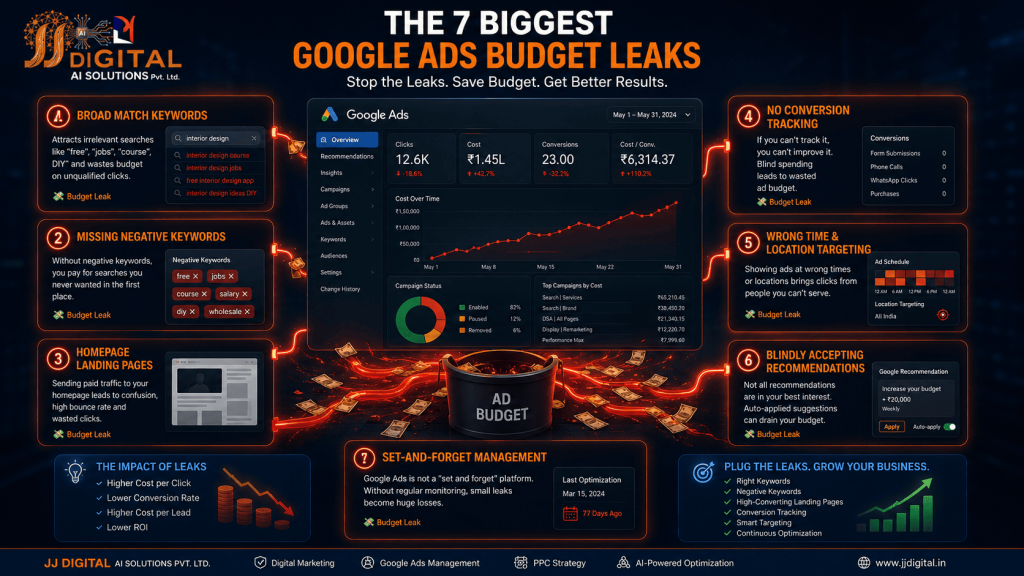
The waste is rarely one big error. It is a set of small, standard leaks that compound. This guide names the seven biggest ones – each diagnosable in your own account today – and exactly how to plug them.
Leak 1: Broad Keywords Buying Irrelevant Clicks
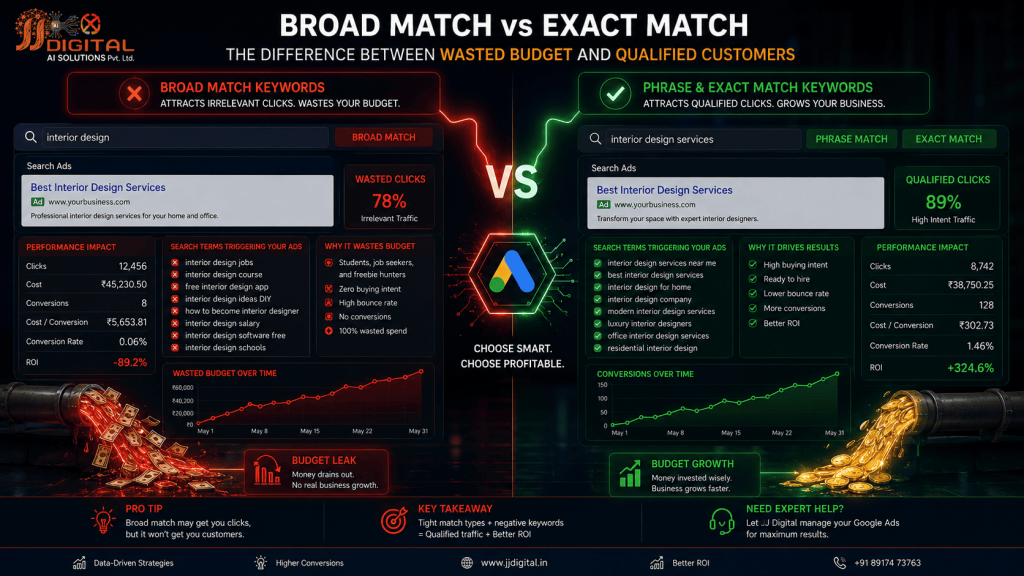
By default, Google matches your keywords loosely. Bid on “interior design” and you may pay for clicks from people searching “interior design course,” “interior design jobs,” “free interior design app” – students, job-seekers, and freebie-hunters, not clients. Every such click costs real money and converts at zero.
The fix: Use tighter match types (phrase and exact) so your ads show for searches genuinely close to your offer, and review the actual search terms report weekly – it shows precisely what searches triggered your ads. Most owners are shocked the first time they read it.
Leak 2: No Negative Keywords
Negative keywords tell Google what searches you NEVER want: “free,” “jobs,” “course,” “salary,” “wholesale,” “DIY.” An account without a negative keyword list is paying for every variation of “how to do this myself for free.” This single omission often accounts for the largest share of waste in self-managed accounts.
The fix: Build a negative list before launch (every industry has obvious ones) and grow it weekly from the search terms report. Every excluded irrelevant search is budget redirected toward actual customers.
Leak 3: Sending Clicks to the Homepage
You pay ₹50 for a click from someone searching “modular kitchen price,” and they land on a generic homepage – sliders, company history, twelve menu items, and the kitchen information three clicks away. They leave in seconds. The click is spent; the lead never existed.
The fix: Every campaign deserves a focused landing page matching the search: one topic, one clear offer, one prominent enquiry form or call button, mobile-perfect, loading instantly. Landing page quality routinely makes a 2–3x difference in cost per lead – larger than any bidding tweak.

Leak 4: No Conversion Tracking
Without tracking, you know your spend and your clicks – and nothing else. Which keywords produce enquiries? Which produce only expense? Which ads work? Nobody knows, so optimisation is impossible and budget flows equally to winners and losers. Flying blind is not a strategy; it is a subscription to waste.
The fix: Set up conversion tracking before spending another rupee: form submissions, call clicks, WhatsApp clicks – every enquiry action measured and tied back to the keyword and ad that produced it. This single setup converts guesswork into engineering.
Leak 5: Wrong Times, Wrong Places
Ads running at 3 AM for a business that answers calls at 10 AM. Ads showing across the entire state when you serve one city. Clicks from areas you will never service still cost full price – and 3 AM enquiries that nobody answers are leads paid for and lost.
The fix: Schedule ads to the hours you can actually respond (or accept after-hours leads deliberately with forms). Tighten location targeting to your true service area – down to a radius if appropriate. Geography and scheduling are free precision; use them.
Leak 6: Blindly Accepting Google’s Recommendations
Google’s interface constantly suggests “optimisations”: broaden your keywords, raise your budgets, switch to automated everything. Some suggestions help; many primarily increase your spend – Google is, after all, the seller in this transaction. Auto-applied recommendations are a common silent budget expander.
The fix: Review every recommendation critically and disable auto-apply. Accept what serves your cost per lead; decline what merely serves your spend. Polite scepticism toward the seller’s suggestions is just business sense.
Leak 7: Set-and-Forget Management
Google Ads is not a crockpot. Search behaviour shifts, competitors adjust bids, costs drift, and ad fatigue sets in. An account untouched for months is an account optimised for conditions that no longer exist – leaking a little more each week.
The fix: A weekly management rhythm: search terms reviewed, negatives added, bids adjusted, underperformers paused, tests running. An hour of skilled weekly attention typically pays for itself many times over in recovered waste.
A Real Business Example
A diagnostic lab arrived convinced Google Ads had failed them: ₹45,000 spent over two months, nine enquiries. The account audit found all seven leaks present: broad-matched keywords pulling “lub technician course” searches, zero negative keywords, all traffic dumped on the homepage, no tracking, ads running 24/7 across two entire districts, and every Google recommendation auto-applied since launch.
The rebuild plugged each leak in order. Same monthly budget, ninety days later: enquiries up nearly six-fold, cost per lead down 80%, and – for the first time – a report showing exactly which tests and localities produced patients. Their conclusion was the right one: they had never actually tried Google Ads before; they had only funded its misconfiguration.
Your 10-Minute Waste Audit
- Open your search terms report – are you paying for irrelevant searches?
- Count your negative keywords – fewer than 30 is a red flag
- Click your own ad – does it land on a focused page or your homepage?
- Check conversions – is anything being tracked at all?
- Check ad schedule and locations – do they match your real service reality?
- Check recommendation history – has auto-apply been spending on your behalf?
Two or more failures means your budget is leaking today – and means significant improvement is available without spending a rupee more.

Frequently Asked Questions
Why am I getting clicks but no enquiries?
The classic pattern: irrelevant clicks (keyword and negative problems) plus a weak landing destination. Read your search terms report to see who is actually clicking, and audit the page they land on. Both are usually implicated.
How much of a typical Google Ads budget is wasted?
In self-managed accounts, industry experience commonly finds a third to half of spend going to irrelevant clicks, untracked activity, and unoptimised targeting. Professionally managed accounts plug these leaks systematically – which is why management typically pays for itself.
Should I stop my ads if they are wasting money?
Pause, audit, rebuild – rather than abandon. The seven leaks are all fixable, and businesses that fix them frequently discover Google Ads works excellently for them. Quitting on a misconfigured account answers the wrong question.
Can Google Ads work on a small budget?
Yes – small budgets simply demand zero tolerance for leaks: exact-match keywords, strict negatives, tight geography, a converting landing page, and full tracking. Precision substitutes for volume.
JJ Digital: We Find the Leaks, Then Stop Them
Most of our Google Ads engagements begin with an audit that shocks the owner – and ends with the same budget producing multiples of the leads. Waste elimination is the fastest ROI in advertising.
What JJ Digital Brings to Your Business
- Forensic account audit – every leak identified and quantified
- Complete rebuild – keywords, negatives, structure, scheduling, geography
- Converting landing pages – because the click is only half the job
- Full conversion tracking – every rupee accountable
- Weekly active management – the discipline that keeps leaks closed
Before increasing your ad budget, recover the part already leaking. Get the audit.
Ready to grow? Contact JJ Digital today for a free consultation. Let us look at your business and show you exactly what is possible.
JJ Digital – Digital Marketing & AI Solutions, Bhubaneswar, Odisha
Leave a Reply