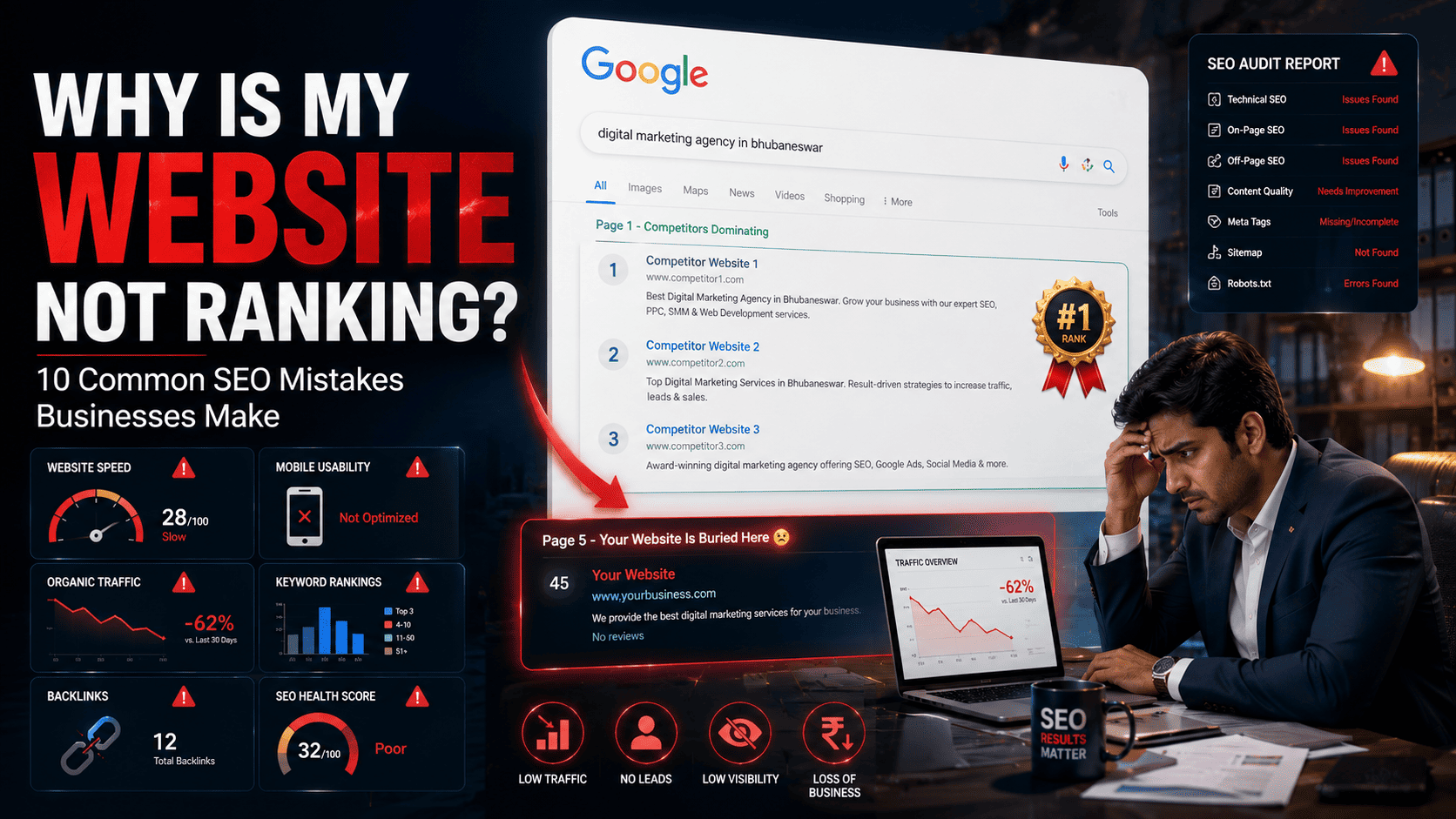
You spent money on a beautiful website. You waited. And nothing happened. No calls, no enquiries, no traffic. When you search for your services on Google, your website is buried on page five, or not showing at all. Meanwhile, competitors with uglier websites sit comfortably on page one, collecting the customers that should be yours.
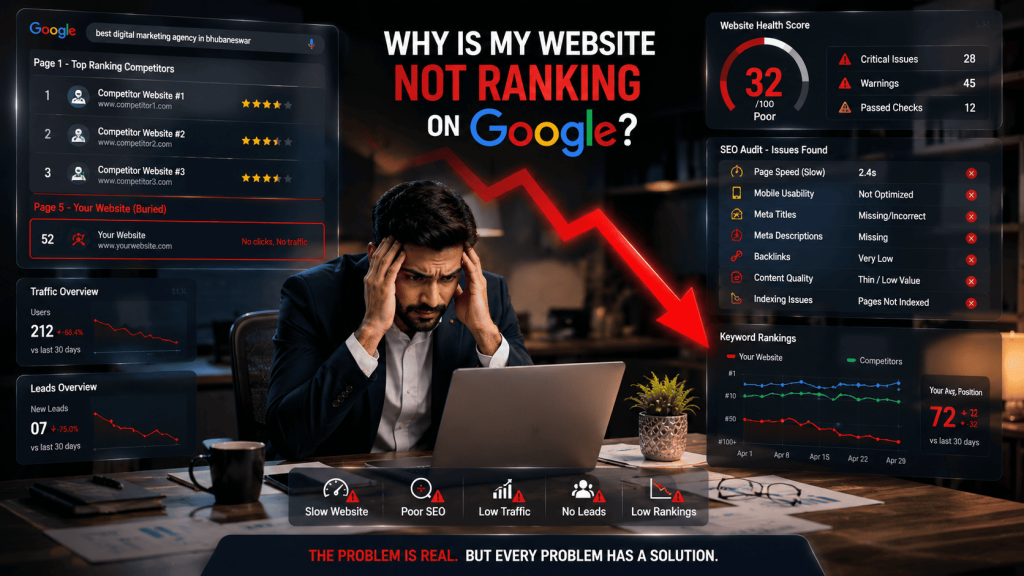
If this sounds familiar, you are not alone. It is the single most common frustration business owners bring to us. The good news: websites do not rank poorly for mysterious reasons. There is always a cause, usually several, and every one of them has a fix. Here are the ten most common reasons websites fail to rank on Google, explained in plain language, with the solution for each.
1. Your Website Is Too New
Google takes time to trust new websites. A site launched last month is competing against sites that have been publishing content, earning links, and serving visitors for years. Google has years of behavioural data on them and almost none on you. This trust deficit is sometimes called the “sandbox” period.
The fix: This does not mean you should give up; it means you need consistent SEO work and patience. Start with low-competition, specific keywords where new sites can win, build content steadily, and understand that rankings build over months, not days. Every established site you envy started exactly where you are.
2. Your Website Is Slow
If your site takes more than a few seconds to load, two things happen: visitors leave before seeing anything, and Google records both the slowness and the leaving. Speed is a confirmed ranking factor, and slow sites are systematically pushed down. The usual culprits are huge uncompressed images, cheap overloaded hosting, and bloated themes stuffed with unnecessary features.
The fix: Test your site with Google’s free PageSpeed Insights tool. Compress every image (free tools do this in seconds), upgrade from bargain-basement hosting, and remove plugins or features you do not actually use. Speed improvements often produce ranking improvements within weeks.
3. It Does Not Work Well on Mobile
Most Google searches happen on phones, and Google now evaluates the mobile version of your site first when deciding rankings, a policy called mobile-first indexing. If your site is hard to read, requires pinch-zooming, or has buttons too small to tap on a phone, your rankings suffer everywhere, including on desktop.
The fix: Open your website on your own phone right now and try to act like a customer: find a service, read about it, and try to contact yourself. Every point of friction you feel is costing you rankings and customers. Modern responsive design fixes this permanently.
4. Your Content Is Too Thin
A website with five pages and two sentences per page gives Google almost nothing to evaluate or rank. Google rewards websites that genuinely help searchers, and help requires substance: detailed explanations, answers to real questions, useful information. “We provide quality services. Contact us.” ranks for nothing.
The fix: Every service you offer deserves its own dedicated page with several hundred words of genuinely useful content: what the service includes, who it is for, what problems it solves, what customers commonly ask, and why your approach works. Write for the customer, and Google follows.
5. You Are Not Targeting the Right Keywords
Your customers search in specific, predictable words: “AC repair near me,” “best CA in Bhubaneswar,” “bridal makeup price.” If your website never uses the words your customers actually type, Google cannot connect you to those searches, no matter how good your business is. Many websites describe themselves in internal company language nobody searches for.
The fix: List ten things a customer would type into Google when looking for your services. Check whether those exact phrases (or close versions) appear in your page titles and content. If not, that is your first content task. Keyword research tools help, but honest customer thinking gets you most of the way.
6. You Have No Backlinks
Backlinks are links from other websites to yours, and to Google, each quality backlink is a vote of trust from the web. A website with zero backlinks looks unknown and unverified, regardless of its content quality. Your competitors on page one almost certainly have links pointing at them; that is part of why they are there.
The fix: Start with the accessible wins: business directories (JustDial, IndiaMART, Sulekha), industry associations, local listings, supplier and partner websites, and local press or community mentions. Avoid buying bulk cheap links – they harm more than help. Authority builds steadily, link by legitimate link.
7. Technical Errors Are Blocking Google
Sometimes the problem is completely invisible: settings that accidentally tell Google not to index your site (often left over from development), crawl errors, broken sitemaps, duplicate page versions, or misconfigured redirects. Your website might literally be invisible to Google while looking perfect to you. This is alarmingly common on sites built without SEO knowledge.
The fix: Set up Google Search Console (free) today. It tells you directly whether Google can see your pages and flags errors. A technical SEO audit catches the rest. This is one area where a professional check pays for itself immediately.
8. Your Competitors Are Simply Doing More
Rankings are a competition, not a queue. If the businesses ranking above you have more content, more backlinks, faster sites, more reviews, and longer consistency, they have earned their positions. Google is not being unfair; it is scoring the match accurately.
The fix: Study the top three results for your target keywords. Count their pages, examine their content depth, check their reviews. The gap you find is your work list. There is no trick around it, but the encouraging truth is that most local competitors stop improving once they rank, leaving them beatable by anyone who keeps working.
9. You Are Ignoring Local SEO
For local businesses, ranking is not only about your website. Your Google Business Profile, your reviews, and your presence in local directories decide whether you appear in the map results, which often appear above the regular results and capture most local clicks. An unclaimed or half-empty profile silently costs you visibility daily.
The fix: Claim your Google Business Profile, complete every field, add real photos, keep hours accurate, and build a steady stream of genuine reviews. For local businesses, this single fix often produces faster results than anything else on this list.
10. You Have No Fresh Content
A website untouched since 2022 sends Google a quiet signal: this business may be inactive. Meanwhile, competitors publishing helpful content monthly give Google fresh pages to rank and fresh reasons to revisit. Stale sites do not crash; they slowly slide as active sites pass them.
The fix: Publish consistently, even just one genuinely helpful article a month answering a real customer question. Update your key service pages a few times a year. Activity compounds; neglect compounds too.

A Real Business Example
Quick Self-Check: Diagnose Your Own Website
- Search your business name on Google – do you appear at all?
- Search your main service + your city – where do you rank?
- Test your site speed on PageSpeed Insights – what score do you get?
- Open your site on a phone – is it genuinely easy to use?
- Count your service pages – does each service have a real, detailed page?
- Check your Google Business Profile – claimed, complete, and with recent reviews?
If you failed two or more of these checks, you have found your answer, and your starting point.
Frequently Asked Questions
Why is my website not showing on Google at all?
Either Google has not discovered your site yet (common for new sites), or a technical setting is blocking indexing. Set up Google Search Console to check directly. If your site is indexed but ranking very low, the causes are usually content, speed, or authority gaps.
How long does it take to fix ranking problems?
Technical fixes can show results within weeks. Content and authority building take months. A realistic full recovery timeline for a struggling site is 3–6 months of consistent corrective work.
Can I fix these problems myself?
Several, yes: claiming your Business Profile, compressing images, writing better content, and collecting reviews are all DIY-friendly. Technical errors and strategy usually benefit from professional help, especially if previous mistakes need undoing.
How JJ Digital Fixes Ranking Problems
Diagnosing why a website is not ranking takes experience; fixing it takes consistent, skilled work across content, technical SEO, and authority building. That is exactly what JJ Digital does for businesses every day.
What JJ Digital Brings to Your Business
- Complete website audit – we find every issue holding you back, including the invisible technical ones
- Technical fixes – speed, mobile, indexing, and structure corrected properly
- Content and keywords – pages rebuilt around what your customers actually search
- Local SEO – Google Business Profile and local visibility fully optimised
- Clear reporting – watch your rankings improve month by month with transparent data
Stop guessing why your website is invisible. Get a professional diagnosis and a clear plan to page one.
Ready to grow? Contact JJ Digital today for a free consultation. Let us look at your business and show you exactly what is possible.
JJ Digital – Digital Marketing & AI Solutions, Bhubaneswar, Odisha
Leave a Reply