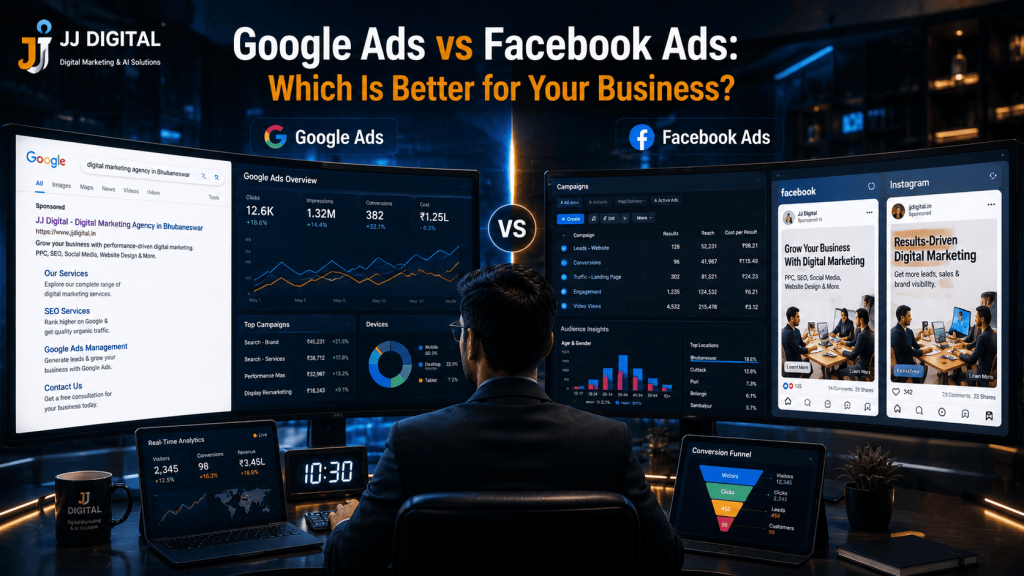
Google Ads vs Facebook Ads: Which Is Better for Your Business?
Every business with an advertising budget eventually faces this fork: Google or Facebook (Meta)? Both platforms have armies of advocates, both have devoured marketing budgets productively and unproductively, and both will happily take your money either way. The honest answer – from an agency that runs both – is that they do fundamentally different jobs, and the right choice depends on one question most comparisons never ask clearly: does your customer already know they want what you sell?
This guide compares the two platforms on the dimensions that actually matter, gives you a clean decision framework, and explains why the most effective advertisers often refuse to choose.
The Fundamental Difference: Intent vs Attention
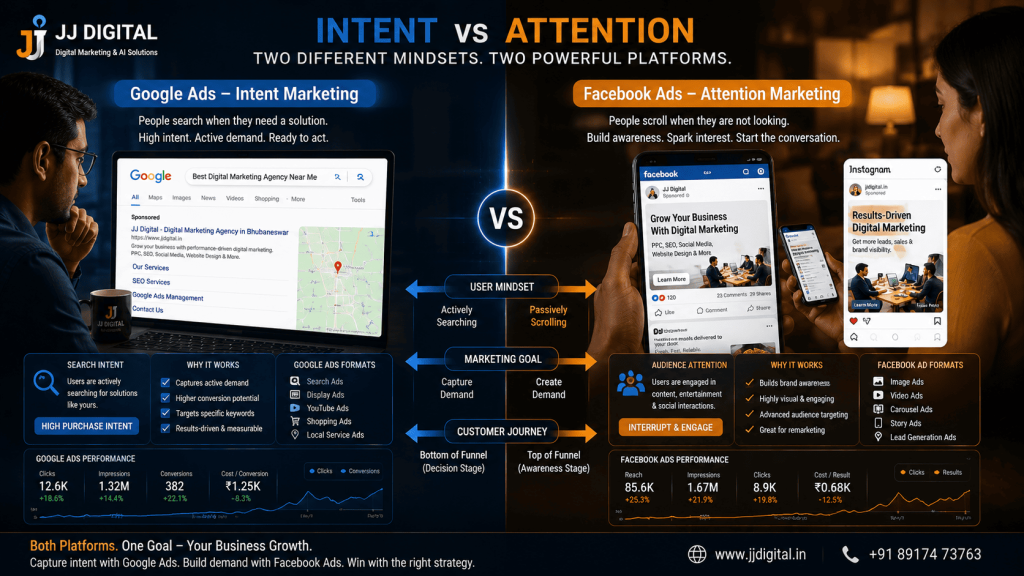
- Google Ads is intent-based. You reach people at the moment they search for what you offer: “plumber near me,” “best CRM software,” “wedding photographer price.” The customer initiated; you answered. Demand already exists – you are capturing it.
- Facebook Ads is attention-based. You reach people while they scroll, selected by their demographics, interests, and behaviour: new parents, gym enthusiasts, small business owners in Bhubaneswar. The customer was not looking; you interrupted well. Demand may not exist yet – you are creating it.
Everything else – costs, creative needs, conversion patterns – flows from this single distinction. Capture versus create. Answer versus interrupt.
Round-by-Round Comparison
Speed to Leads: Google Wins for Searched Services
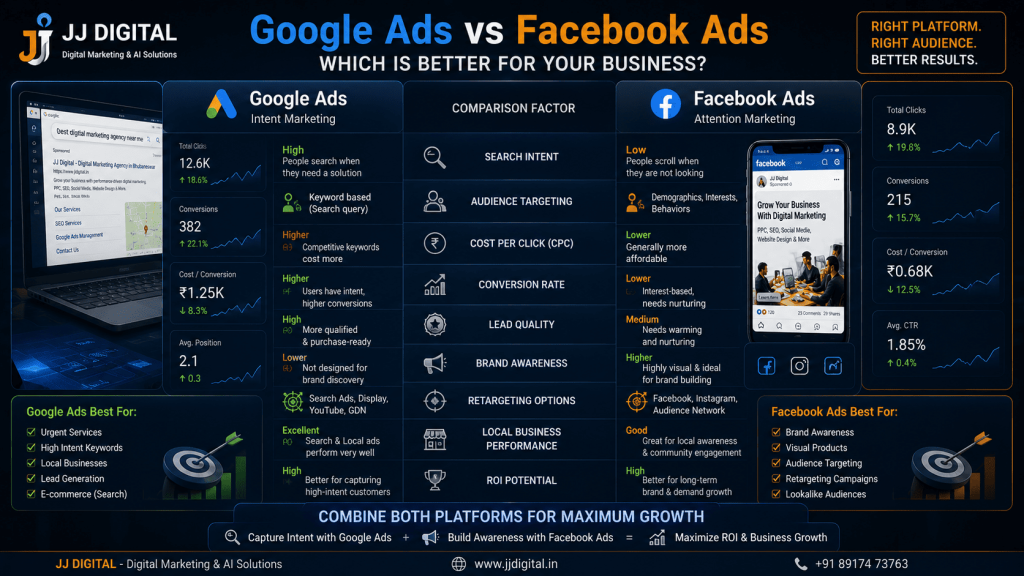
If people actively search for your offering, Google delivers ready-to-buy enquiries fastest – the customer arrives mid-decision. Facebook leads need warming: they were interrupted, not searching, so the path from click to purchase is longer.
Building Demand for New Things: Facebook Wins
If nobody searches for your product because nobody knows it exists – a new D2C brand, an innovative service – Google search ads have nothing to capture. Facebook’s interest targeting and visual formats excel at introducing things people did not know they wanted.
Cost per Click: Facebook Usually Cheaper, Misleadingly
Facebook clicks typically cost less than Google clicks. But comparing CPCs is amateur analysis – a cheap click from a scroller is often worth less than an expensive click from a searcher. The only fair comparison is cost per qualified lead, and there, the winner depends entirely on your business type.
Visual Products: Facebook’s Home Ground
Fashion, food, décor, fitness, events – anything that sells through images and video thrives in Facebook and Instagram’s visual feeds. Google search ads are text; the showroom advantage belongs to Meta.
Urgent and Local Services: Google’s Home Ground
Emergency plumber, AC repair, lawyer, doctor – nobody scrolls Facebook hoping to stumble on an electrician during a power failure. They search. Urgent, need-based, and professional services convert overwhelmingly through search.
Retargeting: Both, Together
Both platforms excel at retargeting – showing ads to people who already visited your site. The strongest pattern: Google captures the searcher, Facebook retargets the ones who did not convert, staying visible while they decide.
The Decision Framework
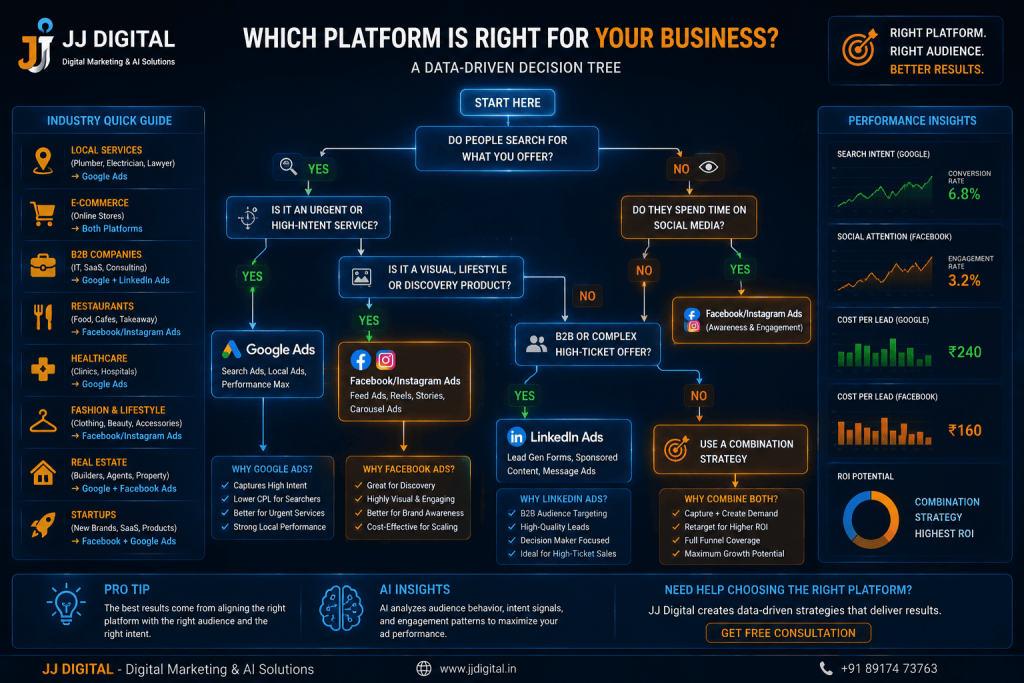
- People search for what you sell + it is urgent or professional → Google first
- Your product is visual, new, or impulse-friendly → Facebook first
- High-value B2B services → Google search for capture, possibly LinkedIn over Facebook for outreach
- Local services → Google (search + maps ads) first; Facebook for area awareness second
- E-commerce → usually both: Google Shopping for searchers, Facebook for discovery and retargeting
- Tight budget, must choose one → follow the intent: if your customer searches, Google; if they must be shown, Facebook
A Real Business Example
A furniture retailer split their budget for a structured 90-day test. Google search ads targeting “sofa set price Bhubaneswar” and similar produced fewer clicks at higher cost – but the enquiries were ready buyers, converting to showroom visits at triple the rate. Facebook ads showcasing room photography produced cheaper clicks, fewer immediate buyers – but built a retargeting audience and a wave of “I keep seeing your designs” walk-ins weeks later.
Their final architecture used both as a system: Google to capture active sofa-shoppers, Facebook to seed desire and retarget Google visitors who left without enquiring. Combined cost per sale beat either platform alone by a wide margin. The lesson they drew: the platforms are not rivals; they are different stages of the same customer’s journey.
How to Split a Budget Between the Two Platforms
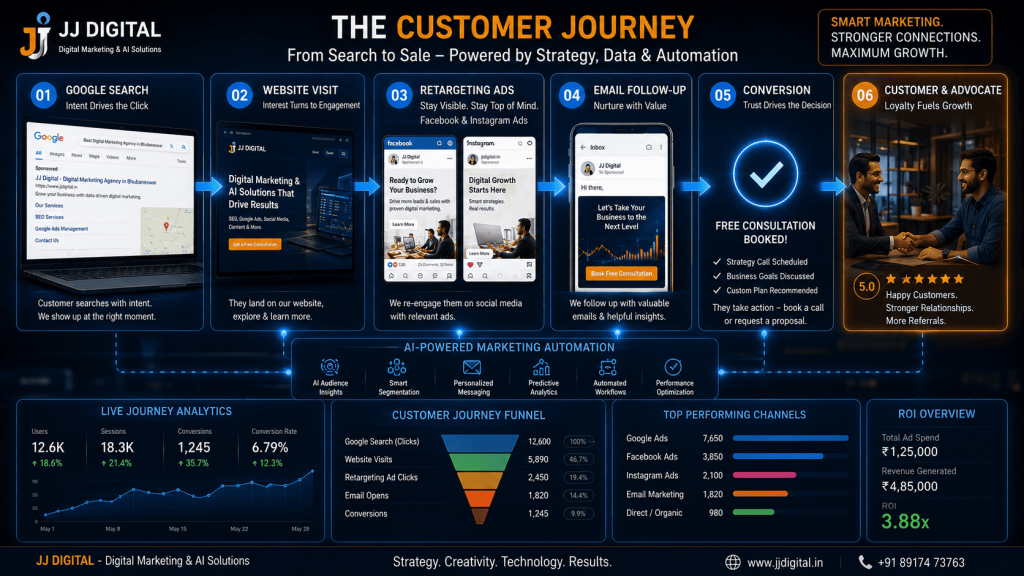
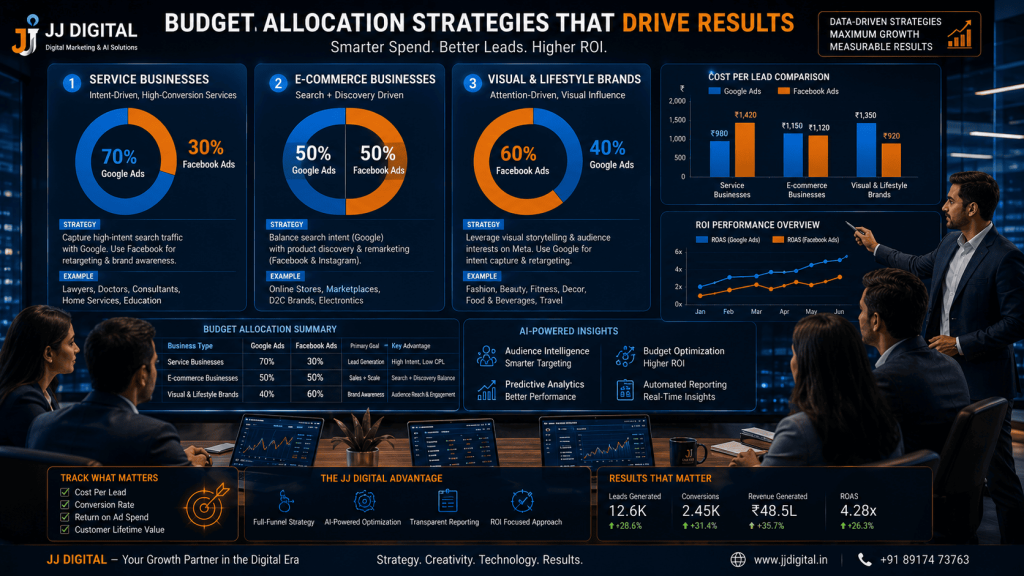
If you run both, the allocation question follows immediately. A practical starting framework: weight the split by where your customer’s intent lives. Searched, urgent, or professional services typically start 70/30 toward Google; visual and discovery-driven products start 60/40 toward Meta; e-commerce often begins near 50/50 with Google Shopping and Facebook retargeting sharing the load. Then – and this is the discipline that matters – let ninety days of tracked cost-per-lead data redraw the split. The starting ratio is a hypothesis; your conversion data is the verdict. Businesses that rebalance quarterly on real numbers consistently outperform those who set a split once and defend it emotionally.
Common Mistakes in This Decision
- Comparing platforms on cost per click instead of cost per qualified lead
- Selling urgent services on Facebook because clicks are cheaper – cheap clicks from people not in need
- Launching search ads for a product nobody searches for, then blaming Google
- Running both platforms with no tracking, making the comparison pure guesswork
- Ignoring the combination play – capture on Google, retarget on Facebook – that usually beats either alone
Frequently Asked Questions
Which gives faster results, Google Ads or Facebook Ads?
For services and products people actively search for, Google delivers buying-stage leads faster – often within days. Facebook builds momentum more gradually, warming audiences who were not actively shopping. “Faster” depends on whether demand already exists for you to capture.
Which is cheaper, Google Ads or Facebook Ads?
Facebook clicks usually cost less, but click price is the wrong metric. Compare cost per qualified lead: intent-driven Google clicks often convert at several times the rate of interruption-driven social clicks, frequently making Google cheaper per actual customer for searched services.
Can I run both Google and Facebook Ads together?
Yes – and for many businesses the combination outperforms either alone: Google captures existing demand, Facebook creates awareness and retargets visitors who did not convert. Start with the platform matching your customer’s intent, then add the second as budget allows.
Which is better for a small local business?
Usually Google first – local service searches (“near me,” “in [city]”) carry immediate intent and convert quickly. Facebook works well as a secondary layer for local awareness, offers, and staying visible in the community.
JJ Digital Runs Both – And Builds the Right Mix for You
Because JJ Digital manages both Google and Meta advertising, our only bias is toward your results. We design the platform mix around your customer’s actual behaviour, then prove it with tracked numbers.
What JJ Digital Brings to Your Business
- Intent analysis first – we determine where your customers actually are before spending a rupee
- Both platforms, one strategy – capture, awareness, and retargeting working as a system
- Cost-per-lead accountability – the only metric that matters, tracked transparently
- Creative and landing pages included – ads are only as good as where they lead
- Honest reallocation – budget flows to whichever platform proves itself in your data
Stop guessing between platforms. Let your customer’s behaviour – and real numbers – decide.
Ready to grow? Contact JJ Digital today for a free consultation. Let us look at your business and show you exactly what is possible.
JJ Digital – Digital Marketing & AI Solutions, Bhubaneswar, Odisha
Leave a Reply